When Logs Break Networks: Why Traditional Analysis Can’t Keep Up
- Amantya Technologies
- 2026-05-25, 01:01 pm
- 1. When Logs Break Networks
- log analyzer , ai log analyzer , Telecom Intelligence
If network operations sometimes feel like chasing smoke, you’re not imagining it.
The modern telecom stack - RAN, 5G Core, Wi-Fi, O-RAN, cloud, edge - is no longer a static system. It is a living, continuously changing environment. Software updates roll out frequently. Traffic patterns shift by the hour. Network functions scale up and down dynamically. Every change produces signals: warnings, retries, timeouts, partial failures, cascading symptoms.
And almost all of those signals surface first in one place: Logs.
The Log Tsunami Is Real
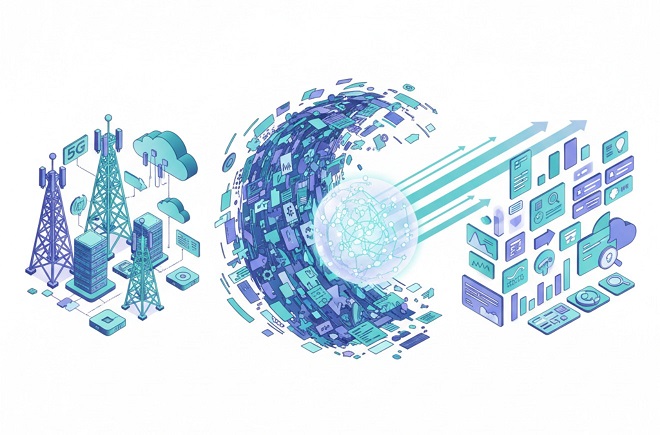
Telecom networks now generate billions of log events per day, across devices, network functions, orchestration layers, and cloud infrastructure. As architectures becomes more distributed, the log surface expands faster than operations teams can manually interpret.
Traffic growth compounds the problem. Industry data shows global mobile data traffic continuing to rise at close to 20% year-on-year, driven by 5G adoption, video usage, and new digital services. When traffic increases inside a distributed, software-defined architecture, logs don’t just grow in volume - they grow in variance and complexity.
This is why traditional log analysis is failing - not because engineers lack skill, but because the system has outgrown the method.
Outages Are No Longer Rare Events
High-impact outages are no longer edge cases in telecom operations.
Industry studies referenced by observability providers indicate that many telecom operators experience frequent service-affecting incidents, with estimated costs reaching millions of dollars per hour once customer experience, regulatory exposure, and remediation effort are included.
Even broader downtime research paints a similar picture. For most large organizations, the cost of downtime regularly exceeds hundreds of thousands of dollars per hour. In telecom - where SLAs are strict and customer expectations are unforgiving - the cost of delayed understanding compounds rapidly.
This shifts the operational question from “How fast can we fix it?” to something more fundamental -
How quickly can we understand what’s actually happening?
Why The Old Playbook Breaks
Traditional log monitoring matured in a very different era. It assumed:
- Errors are known in advance
- Thresholds remain meaningful
- Symptoms map cleanly to causes
In today’s cloud-native, disaggregated telecom environments, none of these assumptions reliably hold.
The same underlying issue may look completely different depending on traffic load, slice behavior, software version, orchestration state, or vendor mix. Logs become high-volume, high-variance, and deeply contextual.
When tools rely on static rules, they fail in two damaging ways:
- They miss unknown failure modes and weak signals
- They generate alert storms that slow down real investigation
Operations teams don’t lack data. They lack coherent understanding.
Logs Are Shifting From Forensics To Signals
Across testing environments and live networks, a clear shift is underway. Operators are moving from using logs as after-the-fact forensic evidence to treating them as live operational signals - telemetry that can indicate degradation before customers experience it.
This shift changes the role of log analysis entirely. Logs are no longer just records of what happened. They are inputs for early detection, correlation, and prediction.
This is where AI-led log intelligence begins to matter - not as a label, or buzz word, but as a method capable of learning behavior, recognizing weak patterns, and correlating signals across domains at machine speed.
The Amantya Perspective: Why Telecom Intelligence Can’t Be Retrofitted
From Amantya’s experience across test labs and live deployments, one lesson stands out clearly: generic IT observability approaches often struggle in telecom environments.
Telecom systems behave differently. They are shaped by signaling flows, mobility patterns, RF conditions, multi-vendor interoperability, and strict QoE expectations. Failures rarely stay confined to a single layer, and the same issue can manifest differently depending on traffic, topology, or orchestration state.
As a result, intelligence in telecom cannot be retrofitted from general IT tooling. It must be engineered for telecom realities:
- visibility across RAN, Core, Wi-Fi, and cloud layers,
- resilience to distributed, cloud-native architectures,
- and applicability across both lab validation and live operations.
This is also why industry investment is shifting rapidly toward AI-driven operations. Market forecasts show strong growth in AIOps adoption, reflecting how seriously operators and enterprises are rethinking operational intelligence in complex, software-driven environments.
Up Next
This is Blog 1 of a three-blog series.
In Blog 2, we’ll explore how AI actually learns to “read” telecom logs - and what separates real intelligence from AI-washed dashboards.
For a deeper architectural foundation, this series pairs with Amantya’s AI Log Analyzer whitepaper, which examines these challenges in greater technical detail.